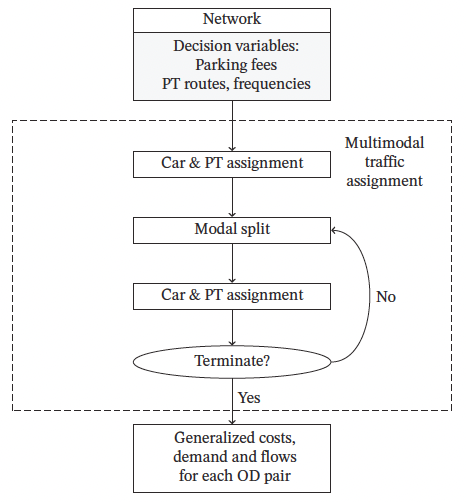
High car usage in urban areas leads to congestion, pollution, and other negative externalities. While both “carrot” measures(enhancing more sustainable modes of transport) and “stick” measures (discouraging car use) are recognized as essential forsustainable mobility, their combined optimization remains underexplored. This study introduces the Transit Network Design,Frequency, and Parking Setting Problem (TNDFPSP), a novel multiobjective framework that jointly optimizes transit routes,service frequencies, and parking fees in a bimodal context. The optimization problem targets three objectives: minimizinggeneralized user costs, car usage, and operator defcit, enabling a systematic analysis of trade-ofs between user, environmental,and operational goals. We propose an evolutionary algorithm tailored to this problem and evaluate candidate solutions usinga multimodal trafc assignment model that explicitly captures car–transit interactions, including parking fees and search times.Experiments on Mandl’s benchmark network show that incorporating parking fees alongside frequencies not only improves allobjectives but also enables better trade-of analysis for policy design. As an illustrative estimate based on modal passenger-kilometers, the resulting solutions are associated with an approximately 3.4% lower CO 2 footprint compared to the baseline TNDP,whereas optimizing transit routes and frequencies alone yields only marginal changes. These fndings highlight the potential addedvalue of integrated carrot-and-stick strategies for sustainable urban transport planning.

Authors: Tygo Nijsten et al
Publication date: 2026