Author: Fatemeh Marzani et al
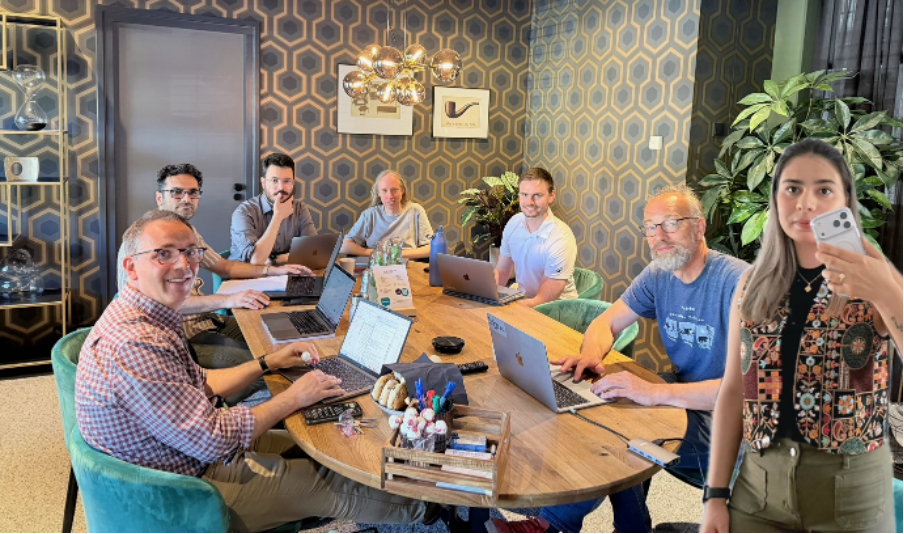
On 23 June 2026, researchers from the University of Twente and Delft University of Technology met in Apeldoorn for a collaborative meeting between Work Package 1 and Work Package 5. The meeting provided an opportunity to share recent research results, receive feedback from consortium partners, and discuss how mobility-monitoring technologies developed within the project can support future Federated Digital Twins and urban simulation platforms.
The research update session began with a presentation by Alex Roocroft, who provided an overview of ongoing work on designing road infrastructure that better balances the needs of pedestrians and vehicles. The research focuses on simulation-based studies investigating how traffic signal configurations and road layouts can be optimised to minimise pedestrian waiting times while maintaining efficient vehicle flow.
A key component of this work is the development of “Green Net” infrastructure concepts, which aim to improve pedestrian movement through signalised urban corridors. The approach explores how traffic signal timings and crossing layouts can be coordinated so that pedestrians experience very low, or in some cases zero, waiting times when moving along a corridor. Recent simulation and optimisation results demonstrated the trade-off between pedestrian service quality and vehicle throughput, highlighting how careful coordination of crossings, signal timings, and corridor design can create more pedestrian-friendly infrastructure without simply shifting delays onto vehicles. These insights also connect directly to the broader WP1 and WP5 objectives, as outputs from mobility monitoring and Federated Digital Twins could support the evaluation of such designs in more realistic urban environments.