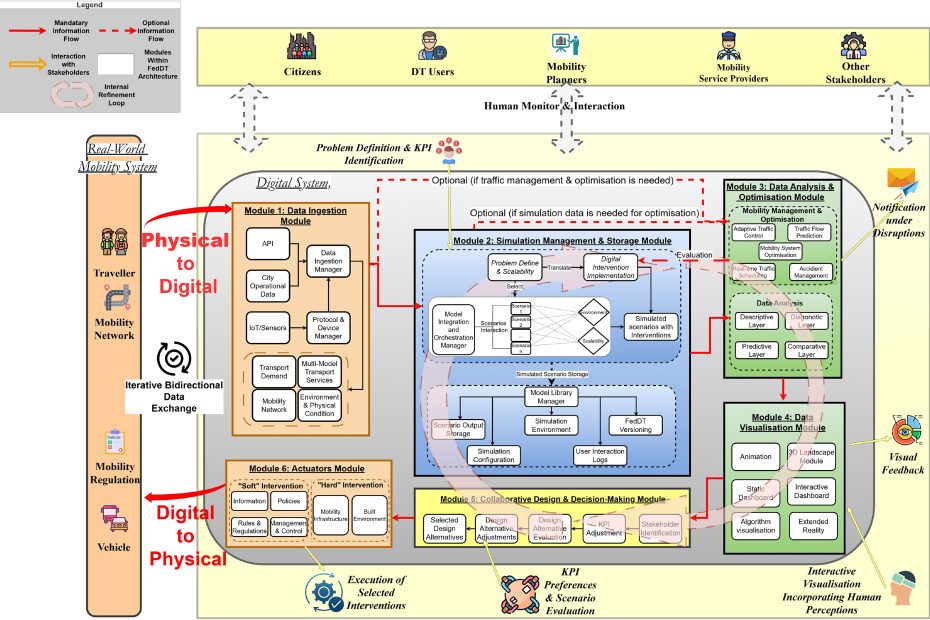
Urban mobility systems face growing challenges. While various smart mobility solutions have been proposed, there is still a lack of comprehensive tools for assessing the impact of these solutions in a dynamic and iterative manner. Recent literature increasingly adopts the Digital Twin (DT) concept. However, DTs have conventionally been framed around automating solutions, which often conflict with the requirements of human-driven planning in socio-technical systems, leading to ambiguities in how DTs should be defined and operationalised for mobility planning. To fill this gap, this paper presents the concept of a Digital Twin Federation (FedDT) designed for comprehensive urban mobility assessments. Firstly, a definition of the FedDT concept is established based on four conceptual pillars, including physical & digital system exchange, system monitoring & planning, outcome evaluation & immersive experience, and human-in-the-loop control. Building on the concept and 5 stakeholder co-design sessions, we present a functional FedDT architecture that enables iterative, bidirectional data exchange between the physical and digital mobility systems, thereby supporting a data-driven decision-making process while ensuring the interests of stakeholders are continuously integrated. Finally, we demonstrate how the FedDT architecture can be instantiated through a proof-of-concept application framework. This framework serves as a research agenda that guides and links the development of separate modules to reduce private vehicle dependency in Amsterdam, the Netherlands. Overall, this work lays a conceptual and architectural foundation for FedDT, advancing the implementation of integrated digital twin solutions for sustainable mobility systems.

Authors: Jingjun Li et al
Publication date: 2026