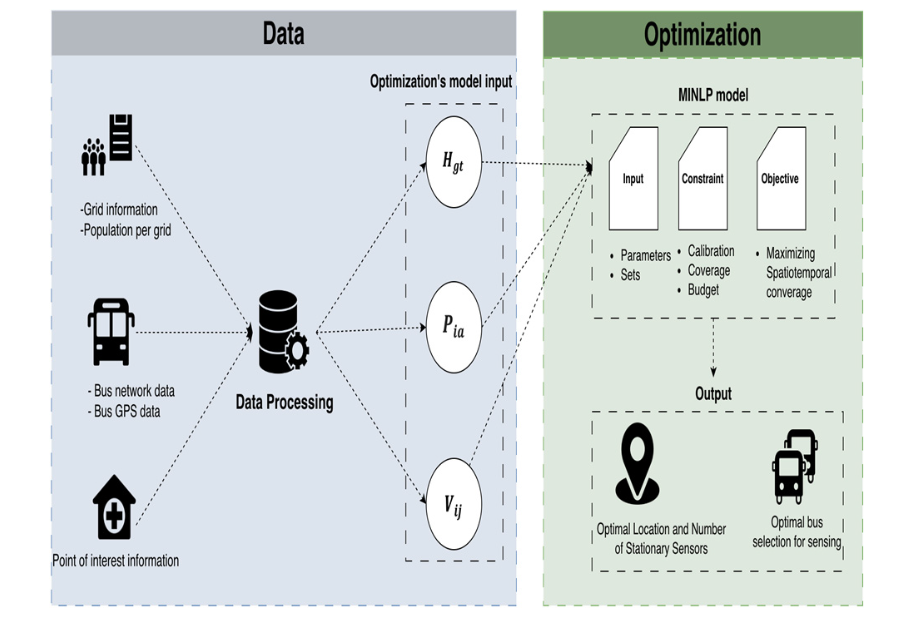
Monitoring air quality is essential for a healthy living environment and can be achieved through various sensor types. While high-cost stationary reference sensors provide precise data, their limited deployment reduces overall coverage. Low-cost mobile sensors (LCSs) can complement stationary sensors, improving both spatial and temporal coverage. However, LCSs suffer from poor accuracy and require frequent calibration. This study presents mathematical optimization models to identify the optimal subset of buses to equip with LCSs and the optimal location of reference sensor stations. The objective is to maximize sensor network coverage while considering budget limitations and ensuring that all mobile sensors are calibrated frequently. The Rotterdam case study demonstrates the effectiveness of the proposed approach in achieving extensive spatiotemporal coverage of residential and industrial areas. The results demonstrate that the joint optimization of mobile and reference sensors enhances both calibration and coverage efficiency.

Authors: Mohammad Jafari et al
Publication date: 2026