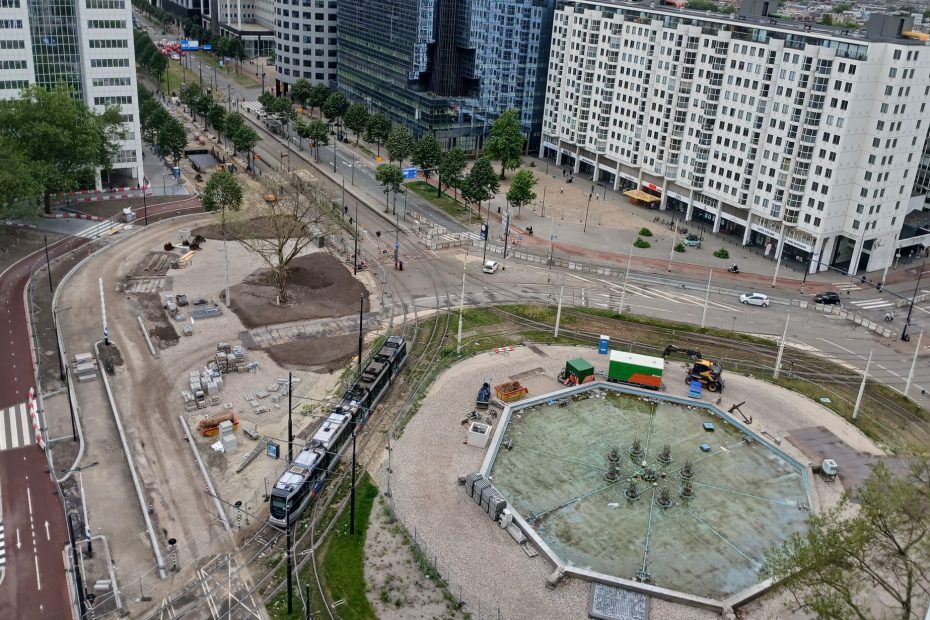
As cities increasingly introduce measures to reduce car accessibility and create more sustainable, liveable urban environments, an important question arises: where do the cars go when road capacity is reduced? While such interventions are often evaluated through changes in traffic volumes and modal shares, less is known about how individual travellers adapt and how these effects are distributed across different groups. To investigate this, the redesign of Hofplein in Rotterdam is used as a practical case study, where a car-oriented traffic square is transformed into a multimodal public space through a reduction in road capacity.
To examine the resulting changes in travel behaviour, an activity-based transport model (ActivitySim) is used to simulate traveller responses before and after the intervention. Accessibility changes are estimated using the V-MRDH traffic assignment model and incorporated into ActivitySim. The model is calibrated against observed modal shares and travel-time elasticities using Bayesian optimisation. Additionally, travellers are assigned to a set of mobility personas to assess how behavioural responses differ between socio-demographic groups.
The results show that the modelling approach reasonably reproduces observed travel behaviour and captures the effects of changes in accessibility. They further reveal that travellers respond to reduced road capacity in different ways, including modal shift, trip rerouting or cancelling trips. These responses are unevenly distributed, with car-dependent personas experiencing the greatest accessibility losses and negative behavioural consequences, while the benefits of reduced car use are more widely shared across society. Overall, the research demonstrates how activity-based modelling can provide valuable insights into traffic redistribution following urban interventions and how their costs and benefits are distributed across different groups. .

Authors: Chris Juárez Overdevest
Publication date: 2026