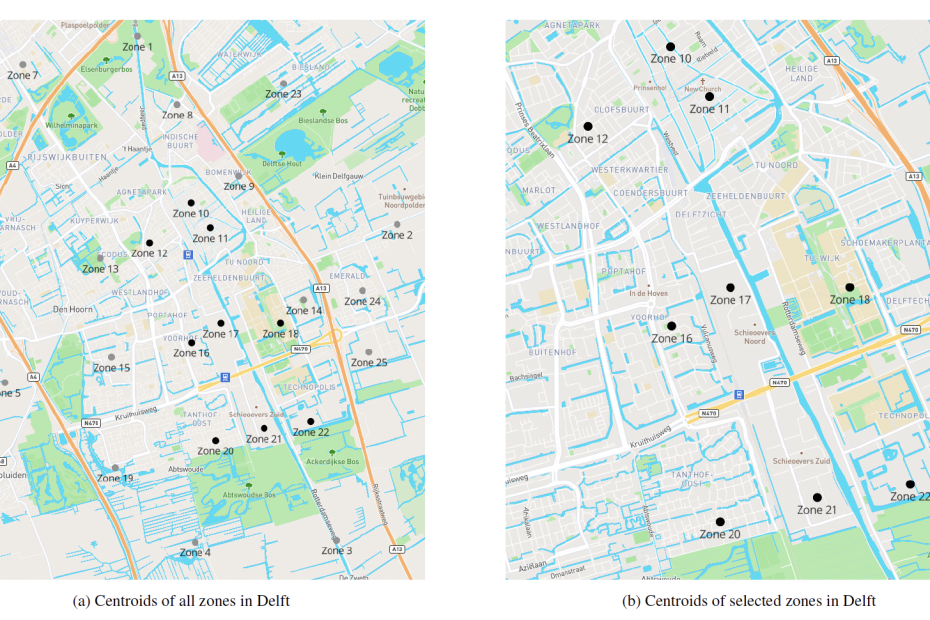
Cars remain the most widely used mode of transport today. However, in many urban areas, high car usage leads to negative externalities such as congestion, pollution, and inefficient land use. Optimising parking policies in cities is a promising approach to reduce these externalities, though it often involves trade-offs; for example, reducing parking space can increase the time drivers spend searching for a spot.We present a model to optimise parking capacities in urban areas using a multi-objective framework that simultaneously minimises (1) travel time, (2) distance travelled by car, and (3) the number of parking spaces. We address this problem using a bi-levelprogramming framework as parking capacity decisions (upper level) influence driver route and parking choices (lower level), which in turn affect the objective values. Our main methodological contribution lies in enhancing the upper level optimisation through a novel mutation operator, which helps achieve lower objective values. We apply our model to the city of Delft, the Netherlands, demonstrating that a diverse set of solutions with low objective values can be obtained. Moreover, we show through an example within this case study that our model can help policy-makers assess trade-offs in the conflicting objectives..

Authors: Tygo Nijsten et al
Publication date: 2026