Author: Dr. Jie Gao
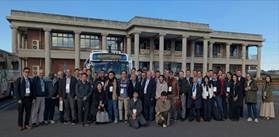
On 7 November 2025, XCARCITY (TU Delft) and the Institute of Industrial Science at the University of Tokyo co-organized a joint workshop on Urban Surface Street Management for Smart Mobility in Tokyo. The workshop brought together researchers, public authorities and industry partners to exchange ideas on how urban surface streets can be (re)designed and managed for safer, more inclusive and low-carbon mobility.
From the Dutch side, Prof. Bart van Arem (TU Delft) opened with an overview of the XCARCITY project, which uses digital twins to study and design “cities without cars”. XCARCITY focuses on real urban districts such as Amsterdam Zuidas and Rotterdam Merwe-Vierhaven, developing federated digital twins for both real-time street and curb management and long-term scenario exploration, including alternative street layouts, parking policies and multimodal hub concepts.
From the Japanese side, Prof. Takashi Oguchi (University of Tokyo) presented the Urban Smart Mobility (USM) project. USM aims to create a society without mobility divides, particularly in the context of ageing populations and shrinking towns. The presentation highlighted how Japanese cities are rethinking surface street space to maintain accessibility and safety while facing demographic change and constrained resources.
Throughout the day, contributions from both countries, and from international partners, highlighted different angles on street management and smart mobility. Japanese colleagues presented work on redesigning residential roads and street hierarchy optimization to better protect pedestrians, especially around schools and in mixed-traffic environments. TU Delft researchers, including Dr. Shadi Sharif Azadeh and Dr. Jie Gao, discussed optimization methods for green micro-delivery services and emerging mobility systems such as ride-hailing and on-demand logistics, focusing on how data and optimization can support more sustainable and user-centric operations.
The programme also showcased tools that bridge analysis and implementation. Partners from The Future Mobility Network shared experiences from real-world pilots with cities and stakeholders, including mobility hubs and school travel initiatives, while Japanese colleagues from Nagoya University and Fukuoka University demonstrated virtual and augmented reality tools for pedestrian safety assessment and the design of traffic calming measures. Dr. Jingjun Li (Heriot-Watt University) presented work on digital twin federation and architecture, and Dr. Yan Feng (TU Delft) showed how extended reality can be used to study pedestrian behaviour, automated vehicle interactions and evacuation strategies in complex environments. Together, these contributions illustrated how digital twins, XR and data-driven models can support evidence-based decisions on how to allocate space on urban streets.
The workshop closed with a discussion on future collaboration. Ideas included joint projects on connected and automated vehicles in complex urban environments, responsible and inclusive mobility, integrated digital twins for road networks, and shared tools to support local governments in designing safe school routes, mobility hubs for older adults, and resilient multimodal corridors. Participants also emphasized the importance of exchanging students and early-career researchers, and of developing accessible outputs for policymakers and practitioners, beyond scientific papers alone.

Following the workshop, the XCARCITY delegation attended the Mobility Innovation Week, organized by the Mobility Innovation Alliance Japan. This provided a broader international perspective on autonomous vehicle developments, with presentations from public and private stakeholders and demonstrations from around the world. The group tested two autonomous bus pilots, gaining first-hand insight into how automated services can be integrated into existing public transport and urban street environments.

In addition to the bus pilots, Prof. Bart van Arem, Dr. Jie Gao and Dr. Yan Feng also joined an impressive Wayve autonomous vehicle ride that took them through some of the busiest parts of Tokyo, including the notorious Shibuya Scramble. The vehicle successfully dealt with many challenging conditions, including responding smoothly to instructions from a traffic assistant, offering a vivid glimpse of how AI-driven vehicles might operate in dense, complex urban settings.
The visit to Tokyo has been highly inspiring for XCARCITY. The combination of Dutch work on digital twins for car-low city and Japanese expertise in designing streets and systems that avoid mobility divides opens up rich opportunities for long-term collaboration. The partners are now exploring next steps, including joint research proposals, shared demonstrators and continued exchanges between teams working on the future of urban streets and smart mobility.